
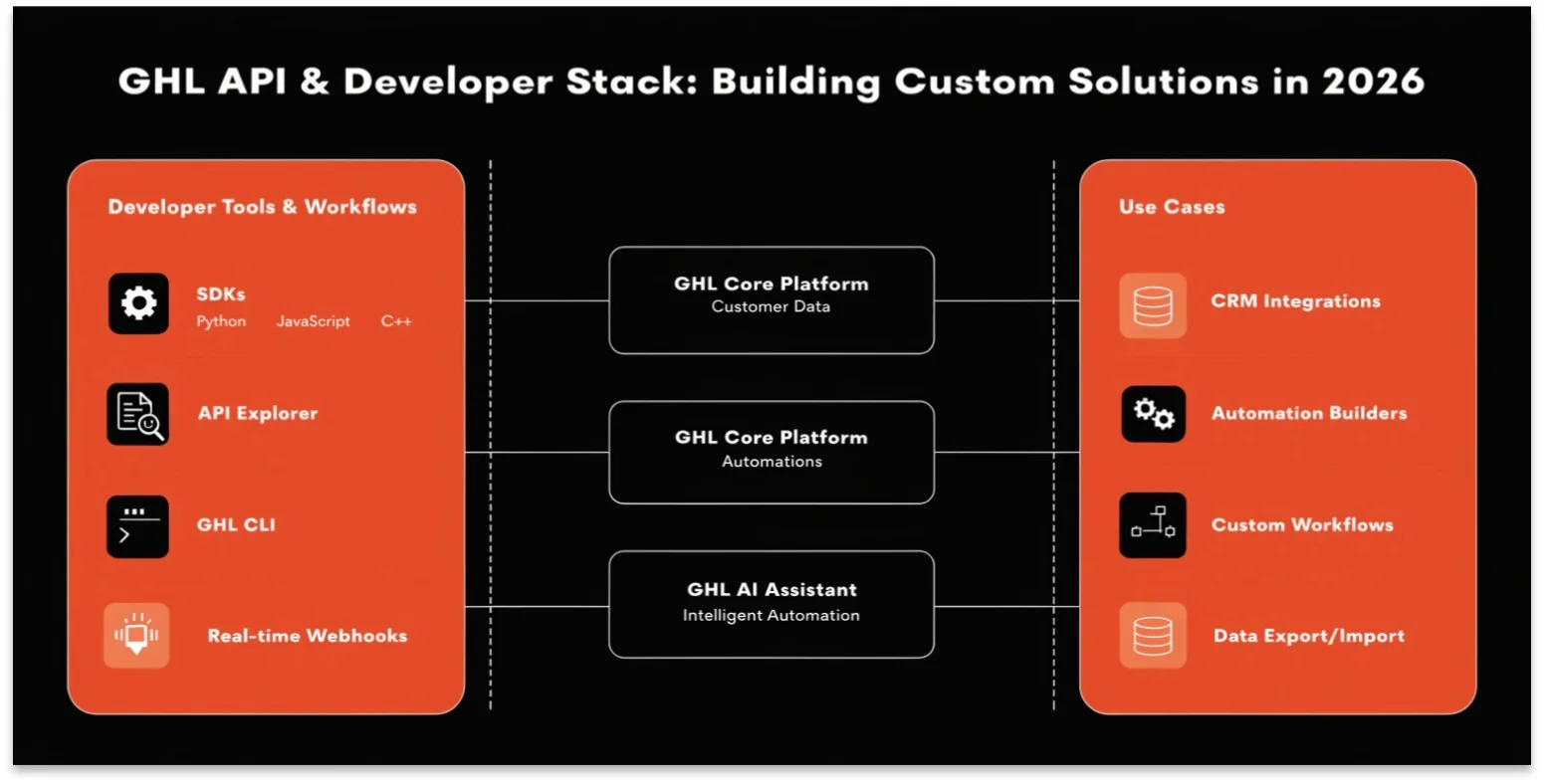
GHL API & Developer Stack: Building Custom Solutions in 2026
GoHighLevel is a powerful “No-Code” platform. But for high-ticket clients and enterprise-level businesses, “No-Code” is sometimes not enough. In 2026, the real power lies in API v2, which allows you to build custom apps, unique widgets, and deep integrations that live right inside the GHL interface.
If you can dream it, you can build it. This guide covers the essentials of the GHL developer ecosystem.
API v2: The Engine of Customization
In 2026, API v1 is officially a thing of the past. API v2 is the current standard, offering better security with OAuth 2.0 and access to almost every part of the CRM.
What You Can Control with API v2:
The GHL Marketplace: From Agency to Software Company
The Marketplace is where you can publish your own “Apps.”
Custom Funnel Widgets & iFrames
Sometimes you just need one specific button or a custom calculator on a landing page.
Read this: The GHL Analytics Stack: Proving Your ROI in 2026
Webhooks: The “Glue” of Real-Time Data
Webhooks are the fastest way to get data out of GHL and into another system.
Security & Rate Limits in 2026
With great power comes great responsibility. GHL enforces strict limits to keep the platform stable.
| Limit Type | The 2026 Standard |
| Burst Limit | 100 requests every 10 seconds. |
| Daily Limit | 200,000 requests per day (per location). |
| Authentication | OAuth 2.0 (Required for all Marketplace apps). |
| Best Practice | Use “Asynchronous Processing” to handle data without slowing down the app. |
Frequently Asked Questions
Do I need to be a pro coder to use the API?
For basic tasks, you can use “Low-Code” tools like Zapier or Make. For building Marketplace apps or custom widgets, you will need a basic understanding of JavaScript and REST APIs.
Where is the official documentation?
You can find everything you need at developers.gohighlevel.com. It includes code samples, endpoint lists, and a developer “playground” to test your calls.
Can I build a custom dashboard for my clients?
Yes! You can use the API to pull data into tools like Tableau or Google Data Studio, or build a completely custom “Command Center” that embeds inside the GHL sidebar.
Summary: Scaling Beyond the Box
The GHL API & Developer Stack is what separates the “Side-Hustlers” from the “Enterprise Agencies.” In 2026, being able to say, “We built a custom solution for this,” allows you to charge 5x more than an agency that only uses standard templates.


